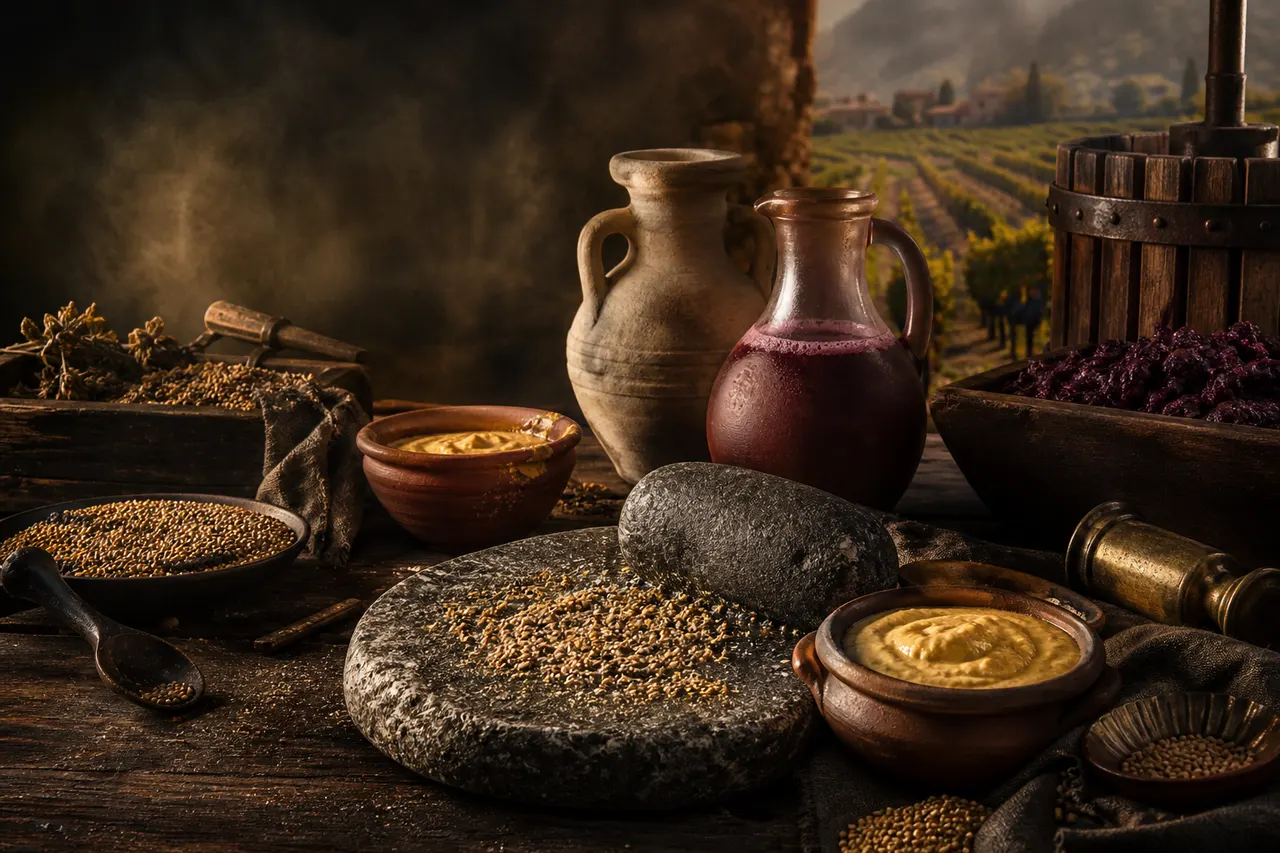
Ancient seed craft
Crushed seed, stone grinding and grape must are the roots of the old-world paste.

Mustard history
Mustard began as an ancient Eurasian seed food, became a sharp Roman paste, was refined in Burgundy, developed powerful German and English traditions, and finally became a global everyday condiment.
The key idea
It was first a plant and a seed, then a spice and medicinal ingredient, and only later the ready-to-eat paste we put on the table. That is why mustard belongs to several food histories at once: ancient Near Eastern grain culture, Asian oil and spice traditions, Roman sauce making, French refinement, German strength and modern everyday cooking.
Crushed seed, stone grinding and grape must are the roots of the old-world paste.
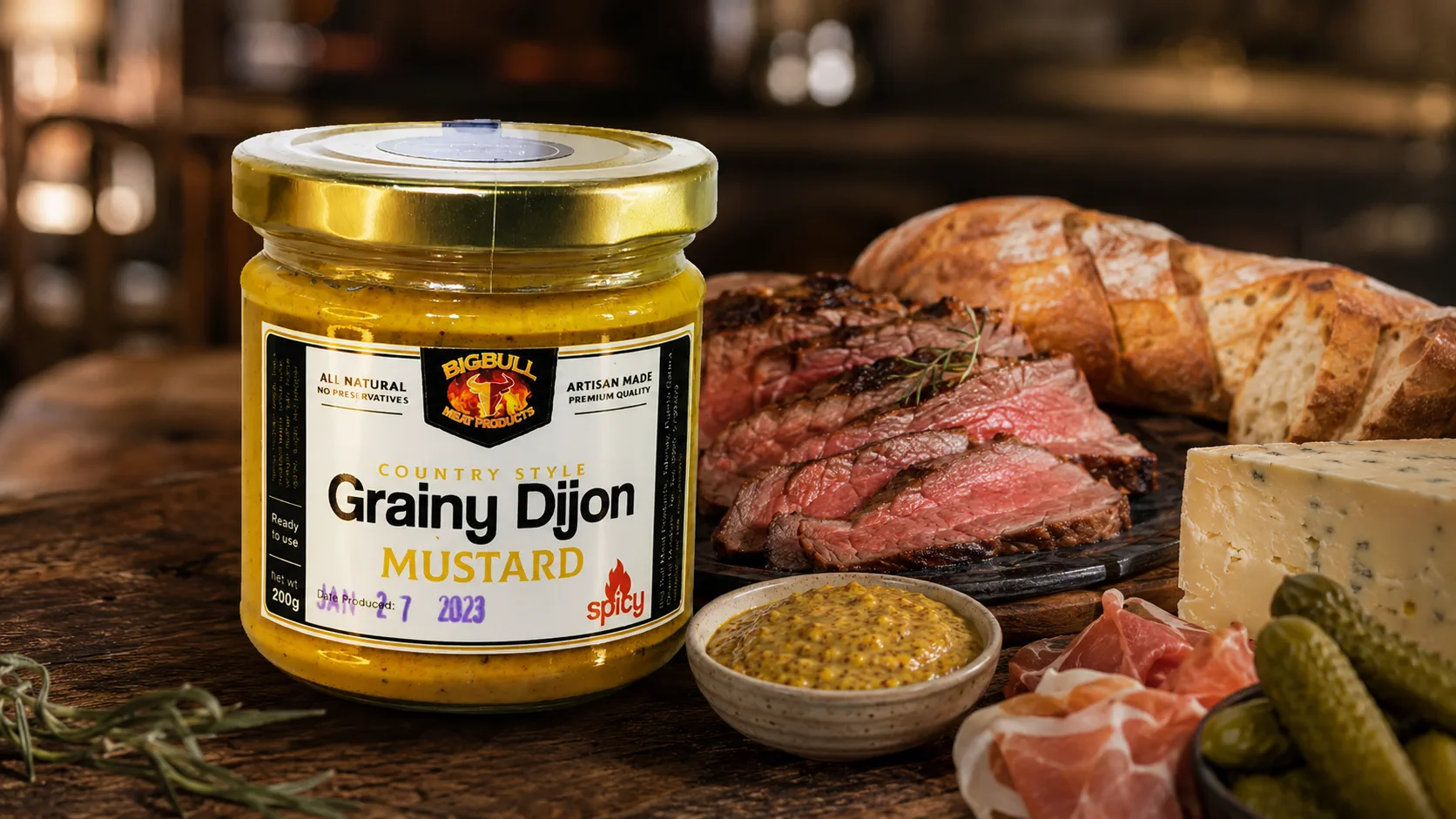
Burgundy refined sharp seed with wine culture, verjus and professional craft.
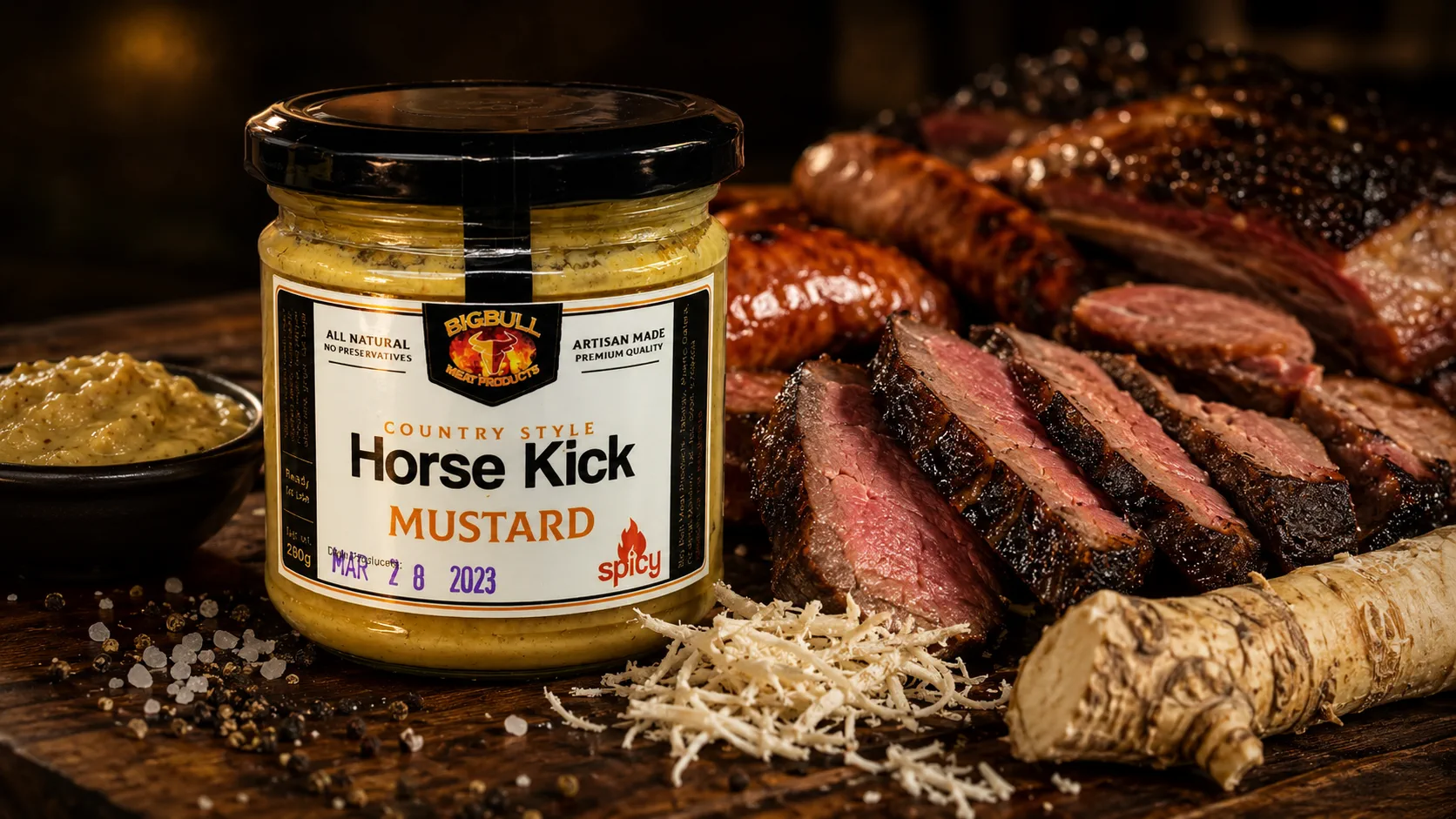
Strong German Mostert stands closer to Dijon and traditional mustard craft than to mild yellow fast-food mustard.
The story
Before the jar
The most important insight comes first: mustard was not invented by one person in one city. Mustard plants were used and cultivated in different parts of Eurasia. The paste we recognize today probably grew out of ancient preparations where crushed mustard seeds were mixed with liquid. For the European mustard tradition, the Romans were especially important.
Three stories
To understand mustard properly, we have to separate the story of the mustard plant, the story of mustard seeds as a spice and healing ingredient, and the story of finished table mustard as a paste. Those three paths overlap, but they did not start at the same moment.
More than 10,000 years ago
At Jerf el Ahmar in present-day northern Syria, archaeologists found a charred flatbread or seed cake on or near a grinding stone. It contained crushed seeds from the crucifer family, the same wider plant family that includes mustard relatives. The find is dated to roughly 9224 to 8753 BC. That does not mean people were making Dijon mustard, but it does show that mustard-like seeds were collected, ground and used as food very early.
Not one plant
What we call mustard mainly comes from several plants: white or yellow mustard, brown or Indian mustard, and black mustard. They belong to the crucifer family, together with cabbage, broccoli, rapeseed and horseradish relatives. Black mustard had a wide natural range from Europe and the Mediterranean to western and northern China and parts of Africa. Brown mustard became an important Asian crop after developing from related Brassica species.
Asia and the Middle East
Mesopotamia, India and China all developed important mustard traditions. Brown mustard, Brassica juncea, appears to have been domesticated very early in Asia, and historical research points to mustard as a spice in ancient Sanskrit and Mesopotamian text traditions. In South Asia, mustard was also an oil crop used for cooking, preservation and practical or medicinal purposes. China built its own old mustard culture around leaves, seeds, oils and pungent pastes.
Greeks and Romans
The Greeks knew mustard as a spice and medicinal plant. The decisive step toward table mustard was probably made by the Romans. They ground mustard seeds and mixed them with grape must, vinegar, wine, honey, oil, herbs and spices. The result was a sharp, sour sauce or paste that appears in Roman food culture and later recipe traditions associated with Apicius.
The word
The common explanation traces the word mustard to the Latin phrase mustum ardens: burning must. Mustum meant grape must, while ardens meant burning or sharp. From there came Old French mostarde, modern French moutarde and English mustard. The name described a preparation made with mustard and must, not a color. The German word Senf follows another line through Old High German senef, Latin sinapi and Greek sinapi.
Burgundy
Through the Roman Empire, mustard growing and mustard making spread into Gaul. Burgundy became a natural center because wine culture supplied grape must, verjus and wine vinegar; mustard could be grown regionally; trade routes were strong; and the Burgundian court supported fine foods and spices. In medieval Europe, mustard mattered because pepper and many imported spices were expensive, while mustard could be grown locally and offered a strong, sharp flavor.
Dijon
Dijon became a professional mustard city with specialist makers known as moutardiers. Its key move was replacing part of the vinegar with verjus, the sour juice of unripe grapes. That made the flavor more elegant, fruity and less flatly acidic. The often repeated story credits a Dijon mustard maker named Jean Naigeon, although sources disagree on the exact date. Today, Dijon often describes a style or recipe, not necessarily the production place.
Germany
Mustard was known in German-speaking regions by the early Middle Ages. Germany later developed many styles: sharp dark Mostert, classic medium-hot mustard, coarse-grain varieties, sweet Bavarian mustard, and herb, beer and specialty mustards. Düsseldorf became especially important when Adam Bernhard Bergrath began making mustard from mustard seed and spirit vinegar in 1726. His initials, ABB, became associated with the famous Aechter Düsseldorfer Mostert.
Industry and America
Until the 18th and early 19th centuries, mustard was often made in small mills and workshops. Industrialization brought more consistent grinding, larger batches, packaging, brands and international distribution. Jeremiah Colman began mustard production in Norfolk in 1814, famous for English mustard powder. In Burgundy, houses such as the later Moutarderie Fallot kept stone milling important because too much heat can damage aroma and pungency. In the United States, bright yellow mustard became its own mild style, boosted by French's at the 1904 St. Louis World's Fair.
The bite
A mustard seed only develops its full pungency when it is damaged or ground and then meets water or another water-based liquid. Plant compounds and enzymes react and form pungent mustard oils called isothiocyanates. That is why mustard heat feels closer to horseradish or wasabi than chili, rising into the nose and sinuses. Cold water can first support a stronger bite, acid stabilizes flavor, time changes the aroma, and heat can drive off volatile sharpness.
So where is mustard really from?
Mustard began as an ancient seed ingredient, became a pungent paste through Greek and Roman cooking, was polished in Burgundy, strengthened by German and English craft, and made globally familiar by American yellow mustard.
The plants come from a huge area spanning the Mediterranean, the Near East, Central Asia, India, China and parts of Africa.
One of the oldest direct food traces comes from present-day Syria more than 10,000 years ago, while South and East Asia built their own ancient mustard cultures.
European table mustard most likely grew from Greek and Roman habits of mixing crushed seed with grape must, vinegar, honey and spices.
The Dijon style developed in Burgundy from sharp seed, wine culture, verjus and professional mustard craft.
Germany built its own regional mustard culture, with Düsseldorf and ABB Mostert becoming a major historical center from 1726 onward.